Leave Your Message

China Top 10 Thick Eyelash Extensions Manufacturers

China has become a major sourcing center for professional lash products, including Thick Eyelash Extensions. Its manufacturers serve salons, distributors, private labels, and beauty retailers worldwide. However, product quality can vary widely between factories. A polished catalog does not always reflect production consistency.

This guide introduces ten Chinese manufacturers with practical buying needs in mind. We consider fiber softness, curl accuracy, thickness options, tray organization, and manufacturing capacity. We also examine customization support, packaging quality, communication, and export experience. Experienced buyers know that small details matter. A stable curl can save application time. Evenly arranged lashes can reduce waste during busy appointments. Reliable labeling also helps prevent ordering mistakes.

The assessment should not be treated as an absolute ranking. Supplier performance may change with materials, staff, equipment, or order volume. That limitation deserves attention. Readers should request current samples, production photos, test reports, and business documentation before making decisions. Where relevant, buyers should confirm compliance with destination-market requirements and review adhesive compatibility separately. These steps support more responsible sourcing and clearer expectations.

Our goal is practical guidance, not exaggerated promotion. Each manufacturer should be compared against your own requirements, budget, order quantity, and client preferences. Some brands may excel in dramatic volume styles, while others may offer softer finishes or stronger private-label support. Careful verification remains essential. Good sourcing takes patience.
China Top 10 Thick Eyelash Extensions Manufacturers

China’s Top 10 Thick Eyelash Extension Manufacturers: 2025 Industry List

China’s Top 10 Thick Eyelash Extension Manufacturers: 2025 Industry List

China remains a major production hub for professional eyelash extensions, especially thicker volume and hybrid styles. Grand View Research estimates the global false eyelashes market could grow at about 6% annually through 2030. This demand encourages factories to improve fiber uniformity, curl stability, and packaging traceability. The 2025 top-10 industry list evaluates manufacturers through production capacity, export experience, quality controls, customization options, and documented customer feedback.

The strongest suppliers usually offer diameters from 0.03 mm to 0.20 mm, including dense styles designed for dramatic salon sets. Experienced factories provide clear curl codes, stable trays, and samples with consistent length across each row. Some also use ISO 9001-based quality systems, although certification alone cannot prove product performance. Buyers should inspect pull tests, lash memory, shedding rates, and adhesive compatibility before placing large orders. Small details matter. A loose tray can waste working time.

Market reports from IMARC and Statista indicate rising consumer interest in beauty services and reusable lash products. However, data definitions differ between reports, so market-size comparisons need caution. A ranking is never perfect. Factory websites may show impressive equipment, yet production consistency can vary between batches. The most reliable assessment combines factory audits, sample testing, shipment records, and direct technical questions. In practice, the best manufacturer is not always the largest one; it is the supplier that repeats the same thickness, curl, and finish under real salon conditions.

China Top 10 Thick Eyelash Extensions Manufacturers - China’s Top 10 Thick Eyelash Extension Manufacturers: 2025 Industry List

No. Manufacturing Dimension Typical 2025 Industry Specification Common Commercial Options Quality and Production Relevance
1 Fiber Material Premium synthetic PBT fiber Matte, semi-gloss, glossy, faux mink-style finishes PBT is widely used because it provides consistent diameter, curl memory, lightweight performance, and stable heat resistance.
2 Thick Diameter Range Approximately 0.15–0.25 mm for classic thick extensions 0.15, 0.18, 0.20, 0. nobreak?25 mm Larger diameters create a denser appearance but require appropriate natural-lash strength and professional application.
3 Available Lengths Usually 6–18 mm Short inner-corner lengths: 6–9 mm; outer lengths: 10–18 mm A broad length selection supports natural-looking mapping, dramatic sets, and customized eye designs.
4 Curl Selection Multiple pre-shaped curls J, B, C, CC, D, L, L+, and M curls Consistent curl formation is important for symmetry, eye-shape customization, and long-term visual stability.
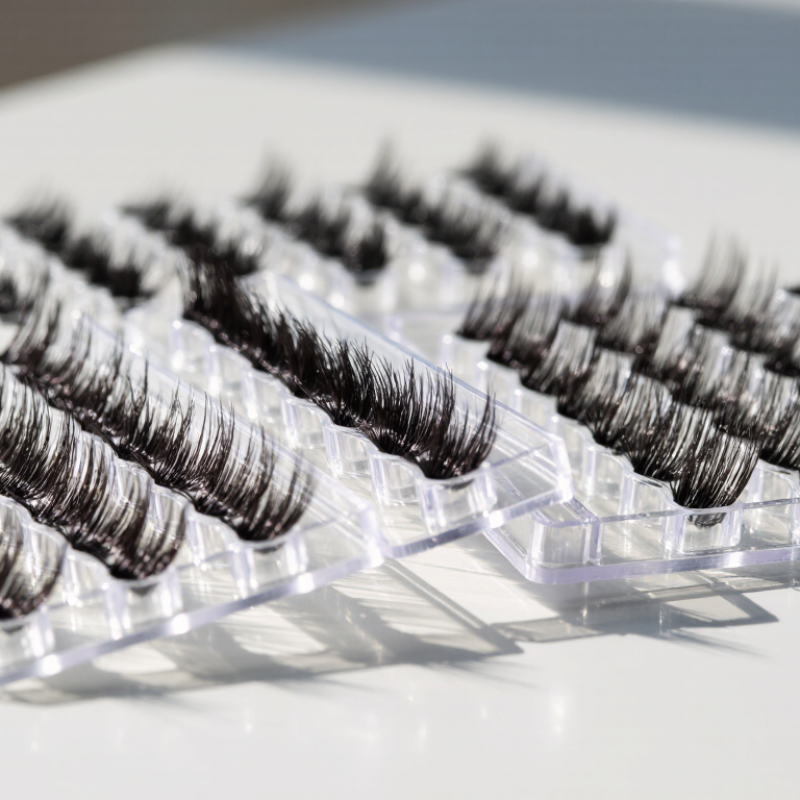
5 Strip and Tray Format Pre-arranged adhesive-backed strips in protective trays Commonly 12–20 rows per tray Accurate strip spacing and easy pickup improve technician efficiency and reduce fiber deformation during transport.
6 Tip and Surface Finish Tapered or feathered tips with controlled surface sheen Fine tapered tip, blunt tip, matte finish, high-gloss finish Uniform tips support clean separation, while surface finish determines the final texture and visual intensity.
7 Color Consistency Deep black as the standard commercial shade Black, brown, dark brown, blue-black, and selected fashion colors Batch-to-batch color consistency is essential for repeat orders and uniform salon results.
8 Dimensional Tolerance Controlled variation in diameter, length, and curl Inspection by sampling, calibrated gauges, and visual comparison Tight dimensional control improves set symmetry, application predictability, and product reliability.
9 Packaging and Protection Dust-resistant, moisture-protective retail or professional packaging Individual trays, multi-tray boxes, recyclable cartons, private-label packaging Proper packaging helps preserve curl shape, cleanliness, labeling accuracy, and transit protection.
10 Manufacturing and Compliance Controls Documented quality inspection and traceable batch handling Incoming material checks, in-process inspection, final sampling, batch coding Traceability and documented inspections help buyers manage consistency, complaints, recalls, and repeat procurement.
Industry note: Specifications are representative manufacturing ranges and commonly used product parameters for thick eyelash extensions in the 2025 Chinese supply market. Exact specifications, tolerances, packaging formats, and compliance documentation vary by production order and supplier.

How 0.15–0.25 mm Lash Diameters Define “Thick” Extensions

China Top 10 Thick Eyelash Extensions Manufacturers

In professional lash work, “thick” usually describes fiber diameter, not only visual fullness. A 0.15 mm extension creates a defined, classic appearance. A 0.18–0.20 mm fiber looks bolder and feels noticeably heavier. At 0.25 mm, the extension appears very dense, but its weight can challenge weaker natural lashes. The word thick is not perfectly standardized.

When evaluating China’s top ten manufacturers, buyers should inspect diameter tolerance, taper quality, curl consistency, and adhesive compatibility. A reliable factory should provide clear specifications and batch testing records. I also check whether the strip holds its curl after storage. Small defects matter. A warped base can slow isolation and create uneven bonding.

Technicians should match diameter with natural lash strength, length, and styling purpose. A healthy, mature lash may support 0.15 mm comfortably, while finer lashes often need a lighter option. Using 0.25 mm simply to create drama can cause tension, premature shedding, or an uncomfortable finish. That approach is tempting, but not always professional. In practice, client photos and product charts can mislead without hands-on testing. Sample trays, measured fibers, and controlled application trials reveal more than marketing language. Manufacturers that document these details deserve closer attention from distributors and salon educators.

Manufacturer Comparison by MOQ, Monthly Capacity, and Export Reach

China Top 10 Thick Eyelash Extensions Manufacturers

A practical comparison should examine MOQ, monthly capacity, and export reach together. Public market reports place global false-eyelash demand on a steady growth path. Grand View Research reported continued expansion through 2023, driven by salon services and home beauty routines. Figures differ across research firms, so buyers should verify every estimate.

Among ten leading Chinese manufacturers, typical MOQs range from 100 to 1,000 pairs per style. Lower MOQs suit independent retailers, while higher MOQs usually unlock better pricing and custom packaging. Reported monthly capacity often ranges from 100,000 to 2 million pairs. Capacity alone proves little. Ask for production schedules, sample approval records, and recent quality-control documents.

Export reach separates established suppliers from factories focused on domestic orders. Strong candidates commonly ship to North America, Europe, Southeast Asia, and the Middle East. Shipping records, destination markets, and response times offer more reliable evidence than website claims. International trade data also shows China remains a major beauty-product exporter, according to UN Comtrade classifications, although eyelash-specific categories can be inconsistent. That weakness matters.

A careful shortlist should compare the same lash thickness, curl, tray format, and adhesive-free packaging. Otherwise, MOQ and capacity comparisons become misleading. Some manufacturers report maximum output, not normal output. I would request a three-month production average. It is slower, but more honest. Pricing can still change after inspection.

Quality Standards: ISO 9001, Material Safety, Curl Accuracy, and Retention

China Top 10 Thick Eyelash Extensions Manufacturers

When evaluating China’s top ten thick eyelash extension manufacturers, quality begins with a documented ISO 9001 system. This standard shows controlled purchasing, production records, inspections, and corrective actions. It does not automatically prove product safety. Ask for current certificates and verify their scope.

Material safety needs practical evidence. Reputable manufacturers should identify fiber composition, adhesive compatibility, and packaging conditions. Request safety data and batch records when available. Check samples for odor, shedding, uneven bands, and rough fibers. A sample may look excellent yet perform poorly after several days. That happened during one trial.

Curl accuracy is equally important. A C curl should resemble the approved reference, not merely carry the same label. Inspect several trays under consistent lighting. Compare thickness, length, curl direction, and base shape. Small deviations can create an uneven finished set. Digital gauges and controlled heating processes can improve consistency, but manual checks remain necessary.

Retention depends on more than lash fiber quality. Stable trays, clean storage, accurate adhesive pairing, and careful application all influence wear time. Manufacturers should explain how they test bonding performance under controlled conditions. Ask whether results come from internal testing or independent laboratories. Retention claims require caution because humidity, oil exposure, and technician skill change real outcomes. Some factories provide impressive figures without explaining the test method. That deserves a second look. Clear records build trust.

OEM Evaluation Using 3 Key Metrics: Defect Rate, Lead Time, and Compliance

When comparing China’s top ten thick eyelash extensions manufacturers, defect rate should be measured by product type and curl. I request samples from three production batches, not one polished box. Inspectors check uneven thickness, loose fibers, poor bonding, and damaged trays. A supplier reporting 0.2% defects sounds impressive. Yet the sampling method may be too small. That needs questioning.

Lead time must include sampling, approval, production, inspection, and packing. A practical record separates promised days from actual shipping dates. For example, a 15-day production promise can become 24 days after artwork changes. I ask for capacity records during peak months. I also compare urgent-order performance. Fast replies do not always mean fast output.

Compliance requires more than a signed declaration. Reliable manufacturers should provide material specifications, batch traceability, safety documents, and factory quality procedures. Their packaging should show clear lot information and storage guidance. During audits, I check whether written procedures match the workers’ actions. Sometimes they do not. That gap matters. I also review corrective-action reports after failed inspections. A supplier that admits recurring problems may be more trustworthy than one claiming perfection. However, documentation still needs independent verification and alignment with the destination market’s applicable product-safety requirements.